
When the C drive is running out of space in Windows Server 2016, using the traditional method to back up files, recreate partitions, and restore everything can waste a whole weekend. Many people ask whether there is a faster and easier solution. The answer is yes, you can extend the C drive in Windows Server 2016 using free space from another partition. To do this, you can choose between Windows' native Disk Management and safe third-party disk partitioning software. This article explains how to extend the C drive in Windows Server 2016 safely using both types of tools.
1. Take Care of System and Data Before Resizing Partitions
Unlike data recovery software, which only reads information from a disk partition, partitioning software will modify the parameters of the associated disk, partition, and files to extend the C drive in Windows Server 2016. In some situations, all files in the partition will be moved to new locations.
Therefore, there is a potential risk of system damage and data loss when resizing partitions. Some unreliable partition software options are known to cause severe partition damage and system boot failure.
For example, if you shrink D to extend the C drive, the start position of drive D and the end position of the C drive will be changed. All files in drive D will be moved to new locations, and all parameters of these files must be modified correctly. In addition, system boot-related files must be updated. Therefore, any incorrect modification can lead to system boot failure and partition damage. Besides software errors, hardware issues such as a sudden power outage can also cause severe damage.
2. Tools to Enlarge the C Drive in Windows Server 2016
Windows Server 2016's native Disk Management tool includes "Shrink Volume" and "Extend Volume" functions to help change partition sizes. However, this tool has two major limitations:
- It can only shrink and extend NTFS partitions. FAT32 and other types of partitions are not supported.
- You must delete the contiguous partition D to get unallocated space. Furthermore, this contiguous partition must be a Primary partition.
Some people think that Windows native tools always have the best compatibility, but that is not always true. Disk Management can cause partition damage under certain complex conditions when shrinking partitions. Extra caution is required when both Primary and Logical drives exist on the same disk.
To enlarge the C drive in Server 2016, third-party software is much more powerful, but you must choose a safe tool. Unlike other utilities, NIUBI Partition Editor features innovative technologies to protect your server system and data:
Virtual Mode
It is designed to work in virtual mode first. All operations you perform will be listed as pending for preview in the bottom-left corner. Real disk partitions won't be modified until you click the Apply button to confirm.
Cancel-at-will
Other software may not allow you to cancel an ongoing operation if you did something wrong. This is because a sudden cancellation can corrupt partition parameters. However, with NIUBI, you can cancel ongoing operations safely at any stage without losing data.
1-Second Rollback
If any software error or hardware issue occurs while resizing and extending partitions, this tool automatically reverts the server to its original status instantly. Your server can go back online rapidly without any damage.
With the help of "Hot Clone" technology, you can clone disk partitions without interrupting the server. You can clone the system disk before resizing partitions or regularly as a backup. Whenever the system disk fails, you can boot from the cloned disk immediately.
In addition, it is 30% to 300% faster because of its advanced file-moving algorithm. It saves a lot of time when you are shrinking or moving a partition containing a large number of files. These features are very helpful when resizing server partitions.
3. How to Extend the C Drive in Windows Server 2016 Safely
In most servers, there is another data partition such as D on the same disk, so you can shrink it to get unallocated space and then add it to the C drive. By doing this, your operating system, programs, and associated settings remain completely unchanged. Unlike Disk Management, NIUBI Partition Editor can create unallocated space on the left when shrinking a partition, so the C drive can be extended easily right after shrinking drive D.
Download NIUBI Partition Editor, and you will see all disks with a graphical partition structure on the right side. Available operations for the selected disk or partition are listed on the left and by right-clicking. In this example, the C drive is 40GB and drive D is 70GB.
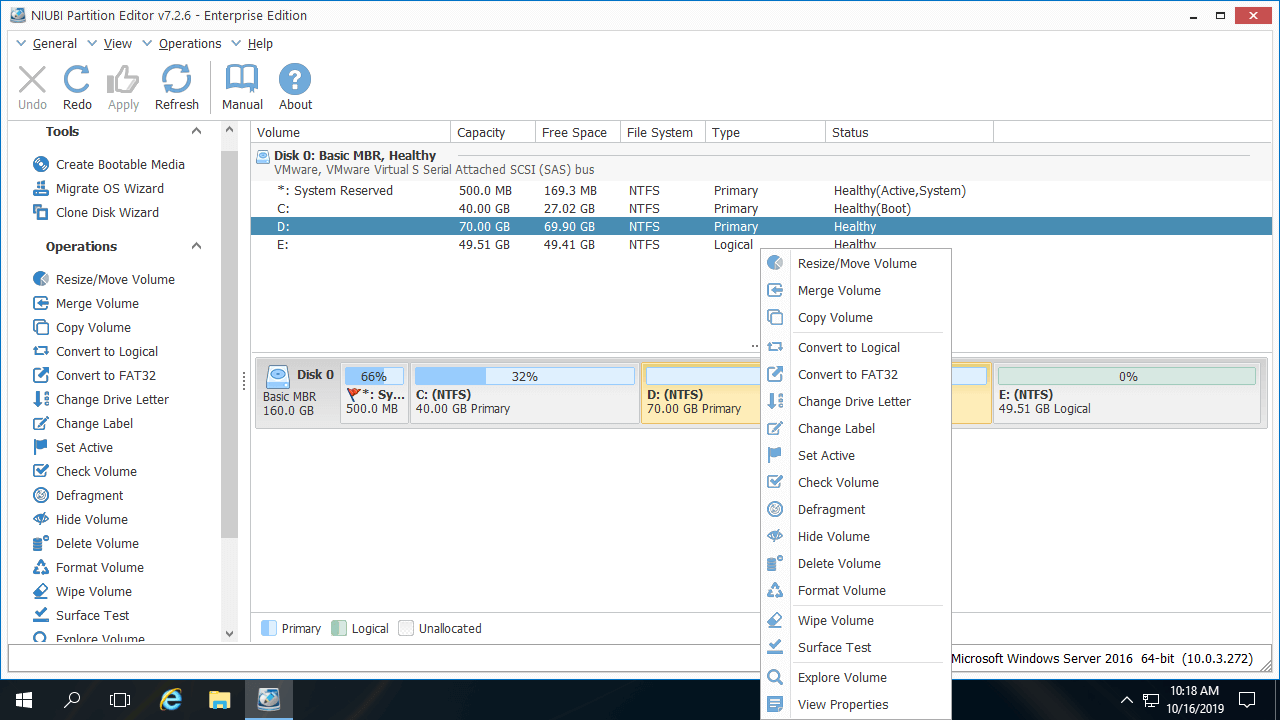
Steps to extend the C drive in Windows Server 2016 safely:
- Right-click drive D: (the adjacent partition) and select "Resize/Move Volume", then drag the left border to the right in the pop-up window to create unallocated space on its left side.
- Right-click drive C: and select "Resize/Move Volume" again, then drag the right border to the right to merge this unallocated space.
- Click "Apply" at the top left to execute the changes.
![C drive extended]()
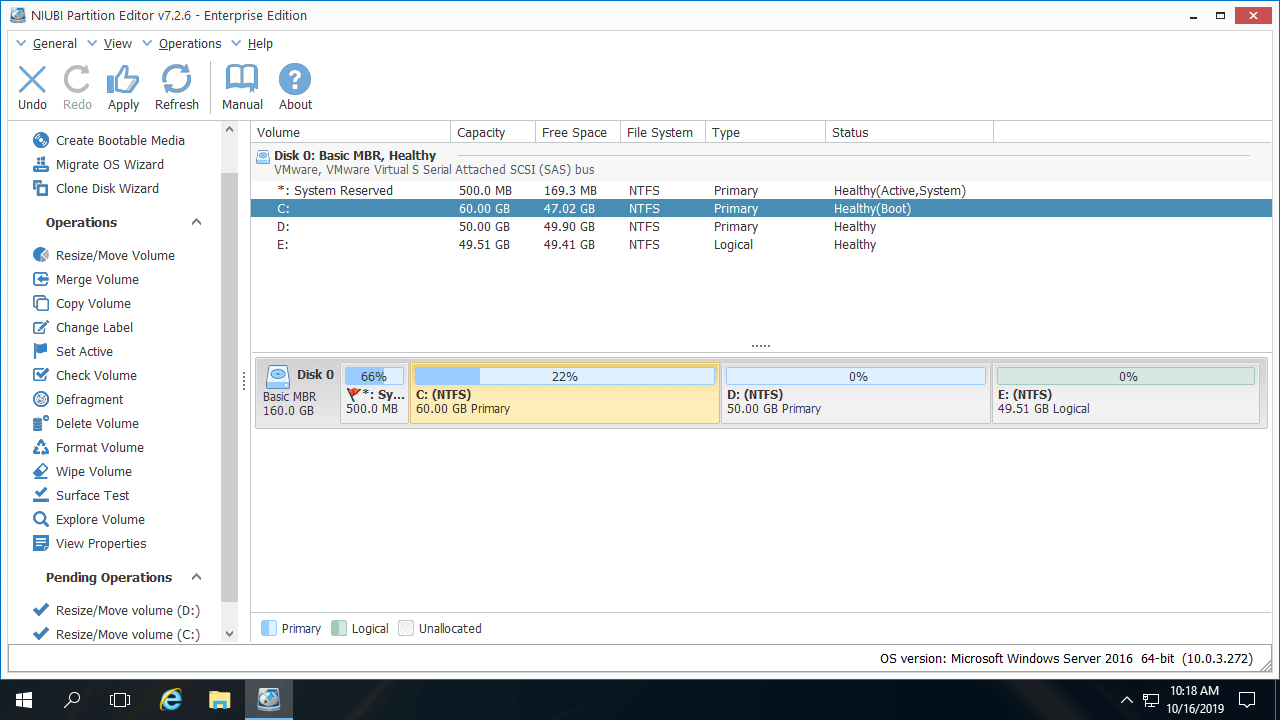
If there is not enough free space in the adjacent drive D, you can shrink non-adjacent partitions on the same disk (such as drive E:). In that case, there's an additional step to move unallocated space to the left before adding it to the C drive.
Follow the technical video guide to expand system capacity safely:
- To move partition D, you need to put the mouse pointer in the middle of drive D and drag it to the right in the pop-up window.
- If you use any type of hardware RAID array, do not break the array or perform any operations on the RAID controller. Just follow the same steps above.
- If there's no other partition or not enough free space on the same disk, no software can extend the C drive in Server 2016 by adding space from a separate hard disk. In that case, follow the steps in the video to expand the C drive by cloning the disk to a larger one.
4. Extend the C Drive inside VMware/Hyper-V Virtual Machines
If you want to extend the C drive in Windows Server 2016 running as a VMware or Hyper-V virtual machine, simply install NIUBI on the guest virtual server and follow the steps above. If there is no available free space on the virtual disk, you can expand this virtual disk directly without copying its data to a larger one. Additional space will be shown as unallocated at the end of the original virtual disk, and then you can merge this unallocated space into the C drive (and other volumes).
- Learn how to increase the size of a virtual disk in VMware virtual machines.
- Learn how to increase the size of a virtual disk in Hyper-V virtual machines.
Besides resizing partitions and extending the C drive in Windows Server 2016/2019/2022/2025 and previous versions like Server 2003/2008/2012, NIUBI Partition Editor helps you perform many other disk partition operations.
 © 2009 - NIUBI Technology All Rights Reserved. |