
Hardware RAID arrays are commonly used in servers. In most cases, RAID 1 is used for the operating system and programs, while RAID 5 is used for saving data. Before saving files to a RAID array, you need to initialize the disk, then create and format partitions. Just like a physical disk, you may need to shrink a large RAID partition to create new volumes, or extend a RAID partition when it runs out of space. This article introduces how to safely resize RAID partitions in Windows Server 2019/2022 without losing data.
Is There Any Difference Between Resizing RAID Partitions and Physical Drives
Many people think it is complicated to resize a partition on a RAID array, but it is not. Hardware RAID arrays are built with two or more physical hard disk drives. After building the RAID array, it is recognized as a single virtual disk in Disk Management. To both the operating system and NIUBI Partition Editor, there is no difference whether you use a single SSD, a mechanical HDD, or a hardware RAID array.
Unlike Windows Disk Management, NIUBI Partition Editor shows the model of all storage devices on the main window. You can clearly see the interface (SATA, SCSI, USB, NVMe, etc.) of a single disk, and the RAID array will also be marked.
When you resize a RAID partition in Windows Server 2019/2022, do not break the RAID array or change any settings in the RAID controller. Just follow the steps below.
How to Resize RAID Partition in Windows Server 2019/2022
Like previous versions, Windows Server 2019/2022 has 2 native tools - Disk Management and the DiskPart command tool. Both tools can shrink and extend partition without losing data in most cases. However, they cannot extend a partition by shrinking another one. To be accurate, they can only shrink an NTFS partition to create new volumes, or extend an NTFS partition by deleting the contiguous partition on the right side.
- How to shrink and extend a partition with Disk Management
- How to shrink and extend a partition with the DiskPart command
To resize a RAID 1/5/10 partition in Windows Server 2019/2022, third-party software is more powerful. However, you should back up the server in advance and run safe partition software. Compared to other tools, NIUBI Partition Editor is much safer and faster because of its advanced technologies:
- Hot Clone - clone disk partitions without server interruption. You can clone the system disk regularly as a backup. Whenever the system disk is down, you can boot from the clone disk directly without wasting time to restore.
- 1-Second Rollback - if it detects any known error while resizing partitions, it automatically reverts the server to its original status in a flash.
- Cancel-at-will - if you applied wrong operations, you can cancel the ongoing tasks at any progress before they finish.
- Virtual Mode - all operations are listed as pending for preview, and real disk partitions won't be modified until you click "Apply" to confirm.
- Advanced file-moving algorithm - shrink, move, and copy partitions 30% to 300% faster.
Launch NIUBI Partition Editor, and you will see all storage devices with partition structures and other detailed information. Available operations for the selected disk or partition are listed on the left and by right-clicking.
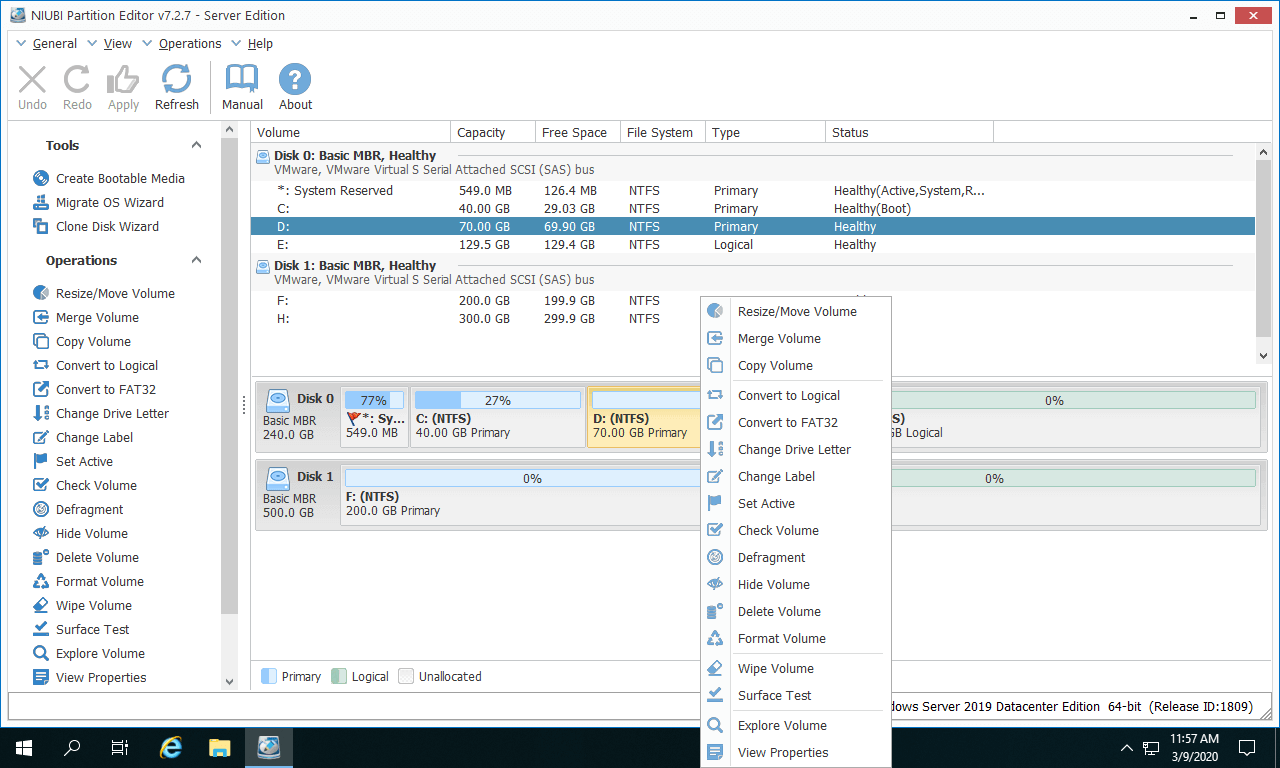
In most cases, there is free space in other virtual partitions on the same RAID array. To shrink and extend a RAID partition in Windows Server 2019/2022, you just need to drag and drop on the disk map. Follow the steps in the video.
How to extend system partition C by shrinking data volume:
How to extend a data partition by shrinking another one:
How to Extend RAID Partition When the RAID Array Is Full
If the RAID array is almost full, it is more complicated than a single hard disk when extending a RAID partition in a Windows server.
To Hardware RAID 1:
RAID 1 is built with 2 hard disks. In most cases, you cannot increase the RAID 1 size by replacing them with larger disks one by one. If you do this, you will get another RAID 1 of the exact same size, and the remaining space on the new disks will be wasted.
Steps to extend RAID 1 partition in Windows Server 2019/2022 safely:
- Build a new RAID 1 with 2 larger disks.
- Follow the method in the video to clone the original RAID 1 to the new one, and extend partitions with the extra disk space.
- Change BIOS settings and boot from this new RAID 1.
If you cannot connect 2 RAID 1 arrays to the server at the same time, follow these steps:
- Insert a single hard disk into this server.
- Copy the original RAID 1 to this disk (there's no difference when copying between a RAID array and a single disk).
- Change BIOS settings and boot from the single hard disk.
- Build a new RAID 1 and copy data from this single disk.
- Boot from the new RAID 1 array.
If your RAID controller has the ability to rebuild RAID 1 without losing data, it is much easier. Just follow the steps:
- Copy the original RAID 1 to one of the larger disks, and remember to extend partitions with the extra disk space.
- Rebuild the RAID 1 array with the other larger disk.
To ensure the new RAID 1 array is bootable, you must clone the entire disk. You can either click Clone Disk Wizard in the top-left corner or right-click the leftmost area of the RAID 1 virtual disk to start.
To Hardware RAID 5:
RAID 5 arrays are built with at least 3 hard disk drives. When the RAID 5 array is full, first make sure your RAID controller can rebuild the array without losing data. If yes, to extend a RAID 5 array in Windows Server 2019/2022, you may either add a new disk or replace the existing disks with larger ones. After rebuilding the array, the additional space is shown as Unallocated space at the end of the disk. Then follow the steps to move and merge Unallocated space to other partitions.
Besides resizing RAID partitions in Windows Server 2025/2022/2019, as well as 2016/2012/2008/2003, this reliable server partition software provides a comprehensive toolkit to merge partitions, scan bad sectors, disk partition clone, convert partition types, erase data, and much more.
 © 2009 - NIUBI Technology All Rights Reserved. |